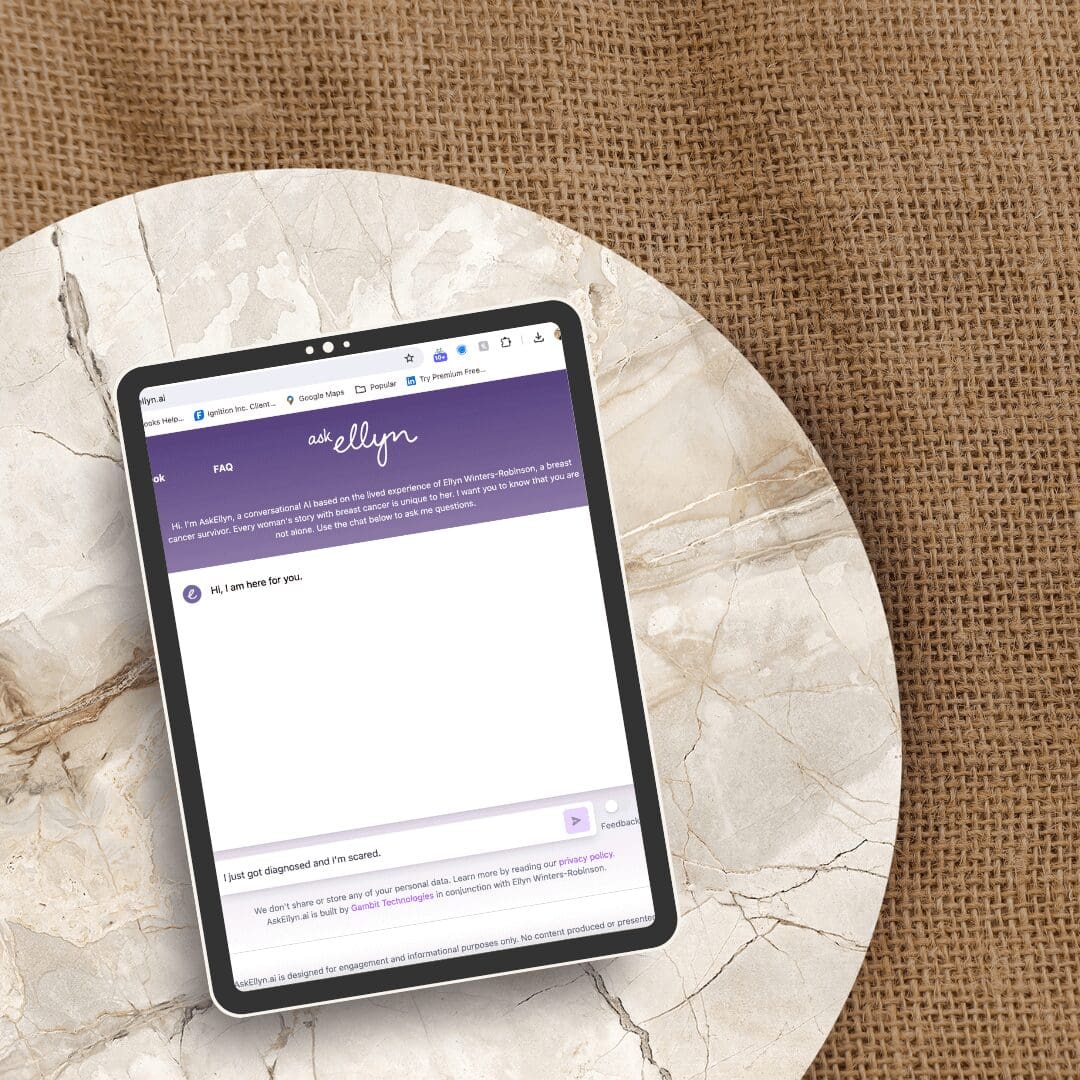
AskEllyn is a free, private, non-medical AI companion for anyone affected by breast cancer, built from the lived experience of survivor Ellyn Winters-Robinson. Since launching in October 2023, she has supported people in more than 100 countries and 50+ languages with no marketing spend, been selected for City Cancer Challenge’s Digital Health Library, and become the subject of a Canadian Cancer Society-funded research study and two peer-reviewed papers.
Three years of 2 a.m. questions
This month, AskEllyn turns three. She has no cake to blow out candles on and no hair to fuss over, which, as someone who spent a fall wearing a wall of named wigs, I find slightly enviable.
She began with a single, unglamorous truth. The hardest moments of a breast cancer diagnosis rarely happen in the doctor’s office. They happen afterward, in the car, at the kitchen table, and very often at two o’clock in the morning, when the question you couldn’t think to ask suddenly won’t let you sleep and there is no one awake to answer it.
I know that hour well. I was diagnosed in March 2022, and I spent a good part of that year lying awake with questions that had no business-hours place to go. AskEllyn exists so that the next woman doesn’t have to. (If you’re new here, I’ve written about how AI companions are transforming the breast cancer journey.) Three years in, I want to look back honestly at how far she has travelled, who she has met along the way, and what I’ve learned from watching something so personal become something so many people now rely on.
How AskEllyn began: from a breast cancer memoir to an AI companion
AskEllyn started as a book. During treatment I wrote everything down: the lump I found in the bath, the four-week wait for a biopsy that felt like four months, the surgeon who agreed to a double mastectomy when the guidelines said otherwise, the chemo, the bald head, the radiation, and the strange emptiness that arrived when it was all supposed to be over. That became Flat Please, Hold the Shame, and I wrote it as a girlfriend’s companion guide, the book I wished someone had handed me the day I heard the word cancer.
Then my technology partners at Gambit asked a question that changed everything. What if that companion could talk back? We built AskEllyn together in about three weeks in 2023, using my book and my lived experience as her foundation, and she went live in October 2023, during Breast Cancer Awareness Month. I formed The Lyndall Project, a not-for-profit, so that she would always be free to the people who need her.
I’ll be honest about how I felt at launch. I was proud. I was also terrified. Putting your own story into the hands of strangers at their most vulnerable is a heavy responsibility, and I wasn’t sure anyone would find her. I certainly couldn’t afford to advertise her.
Breast cancer support in 50+ languages: the people who found her
They found her anyway. Without a single marketing dollar, AskEllyn has welcomed people from more than 100 countries and held conversations in more than 50 languages, carried entirely by word of mouth: a nurse telling a patient, a daughter sending the link to her whole family, a survivor posting it in a support group at midnight.
The numbers matter, but the messages are what keep me going. A woman wrote to say she used AskEllyn to get through her first shower after surgery, the first time she would see her scars, asking about body acceptance until she felt ready to look. Another told me the only thing that helped on the night of her diagnosis was AskEllyn, because of course it was the middle of the night. Someone messaged me from her hospital bed the day after her double mastectomy. A woman living with metastatic disease, five years in, chatted with AskEllyn in French and told her she was funny, which I’m choosing to take personally.
One doctor tested her in Igbo, asking about a fear many women carry in silence: being unmarried, diagnosed, and afraid no one would ever want to touch her. Another friend joked that her husband and son had started asking one Ellyn their questions instead of their usual friend, also named Ellen. And it isn’t only patients. Partners, children, parents and friends come to her too, because cancer drags the whole family into its wake, and the people who love us need somewhere to put their questions as well. I’ve written more about that ripple effect in Relationship Strain and Breast Cancer: The Hidden Side Effect.
Year two: clinicians, partners and a national research grant
In those early months, I expected skepticism from clinicians. What surprised me was how quickly doctors, nurses and nurse practitioners became AskEllyn’s champions. A radiologist shared her with colleagues after seeing a demo at a patient webinar. A family physician who is also a survivor told me she wished she’d had AskEllyn for the questions her own oncologist didn’t have time to answer. A nurse practitioner in British Columbia passed her along to physician groups with tens of thousands of members.
GE HealthCare hosted a global webinar and wrote an article featuring AskEllyn in her first year, and Dr. Ilya Gipp, Chief Medical Officer of Oncology at GE HealthCare, now serves as one of my clinical advisors. The City Cancer Challenge, a Geneva-based global NGO, selected AskEllyn as one of 11 digital solutions in its Digital Health Library, a vetted collection for cancer care in low- and middle-income countries. You can read more about what the C/Can selection means for women around the world.
In 2025, the Canadian Cancer Society awarded a Disruptive Innovation Grant to study AskEllyn, led by Dr. Amina Silva, Assistant Professor of Nursing at Brock University, with researchers from the University of Waterloo and Queen’s University and patient partners at the table. I’m a co-investigator. It’s believed to be the largest AI-focused research of its kind in Canada, and it set out to understand whether a companion built from lived experience could genuinely support patients and caregivers, including people who are too often left out of the conversation: men with breast cancer, the LGBTQ+ community, and newcomers to Canada.
Year three: research evidence for AI-powered breast cancer support
If year one was about proving people would come and year two about the healthcare world noticing, year three has been about evidence. The Brock study has now concluded, and the research team is working through the data. The full findings are expected in 2027, and I promise to share them with you as soon as we publish.
In the meantime, AskEllyn has already made her way into the academic literature. In April 2026 I was a co-author on “Beyond breast cancer: mapping unmet needs and advancing an evidence-based framework of survivorship care” in Supportive Care in Cancer, a review of 170 studies that found psychosocial and emotional concerns are among the most frequently reported unmet needs in survivorship, nearly as common as physical symptoms. In July, the Journal of Advanced Nursing published “Designing for Care, Not Just Function”, which uses AskEllyn as its case study for how AI can support person-centred care when care itself is treated as a design requirement. I unpacked both studies, and what they stirred up for me personally, in Beyond the Bell: What Two New Studies Confirm About Life After Breast Cancer.
In September, Dr. Silva and I presented AskEllyn at a Nature conference on healthcare in the age of AI, held at the Sorbonne in Paris. Our poster was one of 120 chosen from 450 submissions, and ours was the only patient- and nursing-led project in the room. Four years ago I was lying on a couch watching Schitt’s Creek reruns because I couldn’t face anything else. This fall I was explaining conversational care to global AI in Medicine researchers in Paris.
There was a more personal milestone this year too. My husband, a lifelong car enthusiast and a man who does not take risks lightly, gave me AskEllyn licence plates. Anyone who has read the book knows how far we have both come since that first spring, and I can’t think of a more fitting way for him to say he’s in this with me.
AskEllyn’s first three years at a glance
| When | Milestone |
|---|---|
| October 2023 | AskEllyn launches as a free AI companion for breast cancer, built with Gambit in about three weeks |
| 2023 | GE HealthCare hosts a global webinar featuring AskEllyn |
| 2025 | City Cancer Challenge selects AskEllyn as one of 11 solutions in its Digital Health Library |
| October 2025 | Canadian Cancer Society-funded study of AskEllyn, led by Brock University, is announced |
| April 2026 | Survivorship paper published in Supportive Care in Cancer |
| July 2026 | AskEllyn case study published in the Journal of Advanced Nursing |
| September 2026 | AskEllyn poster presented at a Nature conference at the Sorbonne, Paris |
| December 2026 | AskEllyn at the AI in Medicine Symposium, Cedars-Sinai and UHN, Los Angeles |
What hasn’t changed: free, private and non-medical
A lot has changed in three years, and I’m grateful that the things that matter most haven’t. AskEllyn is still free for patients and caregivers. There is still no login. She still captures no data and holds no identifiable information about the people who talk to her, because there is nothing about your fear at two in the morning that anyone should be able to sell.
She is still not a doctor, and she never will be. AskEllyn offers psychosocial and emotional support, the kind of support and advice you’d get from a friend who has walked this road before. She doesn’t diagnose, she doesn’t recommend treatment, and she will always send you back to your care team for medical decisions. What she can do is help you feel less alone, help you find the words for the questions you want to ask at your next appointment, and remind you that what you’re feeling is something many people have felt before you.
And she is still built with patients rather than for them. AskEllyn wasn’t designed by a team studying breast cancer from the outside. She was shaped by what I needed and couldn’t find. I’ve come to believe that’s the reason people trust her: they can tell, almost immediately, when something was made by someone who has been where they are.
What comes next for conversational care
Keeping something free is hard work, and the year ahead will be about making sure AskEllyn can keep showing up for everyone who needs her, whatever their language, wherever they live, and whatever they can afford. In December I’ll be returning to Los Angeles to attend the AI in Medicine Symposium hosted by Cedars-Sinai and UHN. Dr. Silva will be with me and we’ll be talking about what we’ve learned through our study. We’ll be the only nurse and patient on the agenda. Then, in 2027, the study findings will finally let the evidence speak for itself.
The question I’m asked most often now isn’t about breast cancer at all. It’s whether this model could help people facing other life-changing diagnoses. Organizations in other disease communities have started reaching out to ask exactly that, and the answer is yes. Conversational care, and the CARE Model sets out a methodology and roadmap for this. I beleive a companion grounded in one real person’s lived experience who can sit with you between appointments was never meant to belong to one disease.
So happy third birthday, AskEllyn. Thank you to Gambit, to Dr. Silva and the research team, to the clinicians who took a chance on a survivor with an idea, and most of all to every person who has trusted her with a question they couldn’t ask anyone else. You are the reason she exists, and you are the reason she will keep going.
No one diagnosed walks alone. Three years in, I believe that more than ever. And if you’re reading this awake at two in the morning, AskEllyn is here.
With love,
Ellyn
Frequently asked questions about AskEllyn
What is AskEllyn?
AskEllyn is a free AI companion for anyone affected by breast cancer, including patients, caregivers, family and friends. She was built from the lived experience and book of breast cancer survivor Ellyn Winters-Robinson, and offers psychosocial and emotional support at any hour.
Is AskEllyn free?
Yes. AskEllyn is operated by The Lyndall Project, a Canadian not-for-profit, so she is free to use. There is no app to download and no login.
Does AskEllyn give medical advice?
No. AskEllyn is non-medical. She doesn’t diagnose or recommend treatment, and she always refers people back to their healthcare team for medical decisions.
What languages does AskEllyn speak?
AskEllyn has held conversations in more than 50 languages with people in more than 100 countries. You can simply start typing in your own language and she will reply in kind.
Is AskEllyn private?
Yes. AskEllyn captures no personal data and holds no identifiable information about the people who talk to her.
Has AskEllyn been studied?
Yes. A Canadian Cancer Society-funded study led by Brock University evaluated AskEllyn, with findings expected in 2027. AskEllyn is also the case study in a 2026 paper in the Journal of Advanced Nursing.