There are many ways to move your body after breast cancer.
Very few of them truly understand it.
Pilates does.
Not in a flashy way.
Not in a “before and after” way.
Rather, pilates for breast cancer survivors meets us in a quiet, deeply respectful way for a body that has been cut, burned, poisoned, fatigued, rewired — and still wants to feel at home again.
For me, Pilates became that bridge.
I’ve practiced mat Pilates regularly for years, returning to it again and again because it felt safe, intelligent, and kind. More recently, I added reformer Pilates — and it introduced an entirely new dimension of strength, support, and possibility.
Not because it pushed me harder. But because it supported me better.
For breast cancer survivors, that distinction matters.
The Body After Breast Cancer Is Not Just “Deconditioned”
After surgery, chemotherapy, radiation, and ongoing endocrine therapy, the body is not simply out of shape.
It is:
- Healing from trauma
- Adapting to structural changes
- Managing fatigue and joint pain
- Living with scar tissue and altered sensation
- Rebuilding trust and safety with a body that may feel like it betrayed you
The American Cancer Society confirms that long-term physical effects — including fatigue, pain, reduced mobility, and musculoskeletal changes — are common well into survivorship.
👉 https://www.cancer.org/cancer/survivorship/long-term-health-concerns/long-term-side-effects-of-cancer.html
Traditional fitness often treats these realities as obstacles to overcome.
Pilates for breast cancer survivors treats them as information.
Pilates for Breast Cancer Survivors Meets Our Body Where It Is
One of the most powerful things about Pilates for breast cancer survivors is that it does not assume symmetry, readiness, or strength.
It asks:
- How does your body move today?
- Where is there restriction?
- Where is there compensation?
- Where can we create support before demand?
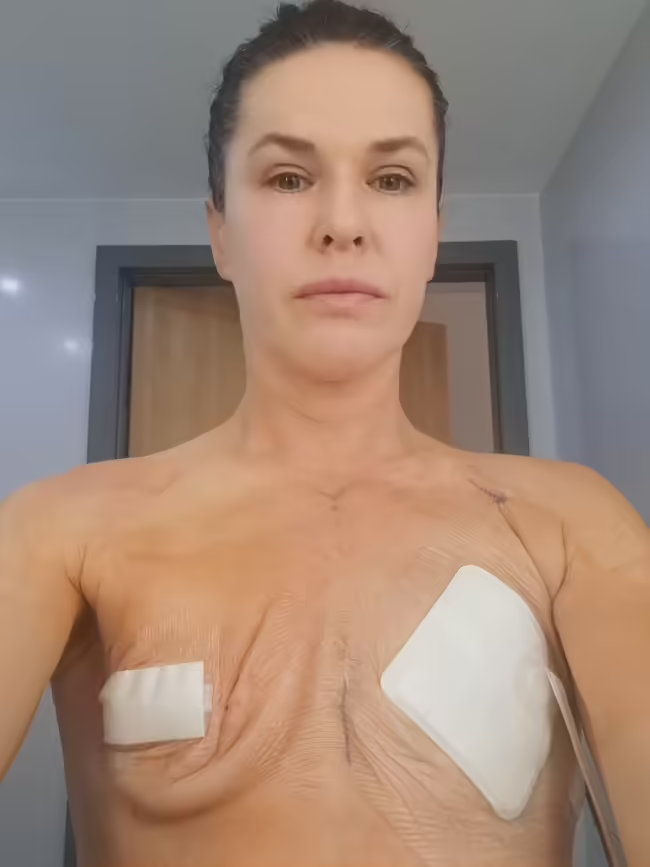
After breast cancer surgery — whether lumpectomy, single mastectomy, double mastectomy, reconstruction, or aesthetic flat closure — many people experience ongoing tightness (also called iron bra), postural changes, and guarded movement.
If this resonates, AskEllyn explores these lived realities more deeply in life after a double mastectomy and what it means to inhabit a changed body.
👉 https://www.askellyn.ai/blog/double-mastectomy
Pilates works slowly and intentionally with all of this.
Nothing is rushed.
Nothing is forced.
Everything is adaptable.
Core Strength Without Aggression
“Core work” after breast cancer can feel intimidating — especially after surgery, drains, radiation, or long periods of guarding the torso.
Pilates reframes the core not as something to punish, but something to reconnect with.
It emphasizes:
- Breath coordination
- Deep stabilizing muscles
- Control over momentum
- Integration, not isolation
This approach aligns with survivorship-focused movement guidance from OncoLink, which recommends gradual, individualized strengthening to benefit muscles and bones.
👉 https://www.nccn.org/patients/guidelines/cancer-survivorship
On the pilates mat, this often looks like small, precise movements.
On the pilates reformer, the springs provide feedback and assistance — helping rebuild strength while feeling supported.
Why Reformer Pilates Adds a New Dimension in Survivorship
When I added reformer Pilates to my practice, I felt the difference immediately.
Not because it was harder — but because it was smarter (and fun!)
The reformer:
- Supports the body through movement
- Offers both resistance and assistance
- Reduces load on joints affected by hormone therapy
- Encourages balanced movement when the body feels asymmetrical
- Builds strength without impact
For survivors managing joint pain, stiffness, or fatigue, this is critical. I am also fortunate that the studio where I practice is owned by a registered physiotherapist who is able to help me move in a way that addresses the ongoing physical imbalances and joint issues I experience in survivorship.
According to BreastCancer.Org, tailored low-impact exercise can significantly improve mobility, confidence, and quality of life after treatment and contributes to a lower risk of recurrence.
👉 https://www.breastcancer.org/managing-life/exercise
Reformer pilates allows strength-building without overwhelming the nervous system — an essential consideration after chemo and radiation.
Pilates and Post-Surgical Healing
Healing after surgery isn’t just about incisions closing.
It’s about:
- Restoring mobility
- Preventing long-term stiffness
- Reclaiming posture
- Reconnecting mind and body
Pilates for breast cancer survivors supports:
- Shoulder and thoracic mobility
- Gentle chest opening (without forcing)
- Postural alignment after months of protective hunching
- Controlled strengthening around scar tissue
This is especially relevant for survivors navigating body image, clothing, and visibility after surgery — themes AskEllyn explores through flat fashion and post-mastectomy confidence.
👉 https://www.askellyn.ai/blog/flat-fashion
Pilates for breast cancer survivors respects healing timelines.
You don’t need to “bounce back.”
You need to rebuild thoughtfully.
Pilates After Chemo and Radiation: Working With Fatigue, Not Against It
Chemotherapy and radiation often leave behind:
- Profound fatigue
- Neuropathy
- Reduced stamina
- Heightened nervous system sensitivity
The American Cancer Society notes that regular, moderate exercise can help reduce cancer-related fatigue — but only when it’s appropriately paced and individualized.
👉 https://www.cancer.org/cancer/survivorship/be-healthy-after-treatment/physical-activity-and-the-cancer-patient.html
Pilates for breast cancer survivors is uniquely suited to this phase because:
- Sessions can be short and effective
- Movements are controlled and predictable
- Rest is built into the practice
- Progress is measured in quality, not exhaustion
On low-energy days, Pilates still offers something meaningful: breath, circulation, and a sense of agency.
Movement That Rebuilds Trust
Perhaps the most important gift Pilates for breast cancer survivors offers is trust.
Trust that:
- Your body can move safely and you are safe in your body
- Sensation doesn’t always mean danger
- Strength can return without punishment
- You are allowed to go slowly
This philosophy echoes AskEllyn’s broader approach to survivorship — including reflections on hair regrowth, identity, and adapting to change in the chemo curls journey.
👉 https://www.askellyn.ai/blog/chemo-curls
Pilates for breast cancer survivors asks you to listen, notice, and respond.
For a body that has been scanned, measured, medicated, and judged — that kind of listening is profoundly healing.
Pilates Is Not About Fixing Your Body
It’s about inhabiting it.
After breast cancer, many survivors are tired of fixing:
- Fixing scars
- Fixing fatigue
- Fixing weight
- Fixing posture
Pilates for breast cancer survivors offers a different relationship.
It says:
Let’s work with what’s here.
Let’s support what’s healing.
Let’s build strength without shame.
That’s why it has become such a meaningful part of my own life — through mat work, and now through the added dimension of reformer practice.
Not because it promises transformation.
But because it supports continuity.
Pilates for Breast Cancer Survivors: Considerations
A few gentle suggestions:
- If you are still healing, in treatment, or have health concerns, speak to your care team (including a physiotherapist) before engaging in exercise
- Look for pilates instructors experienced in rehab or post-surgical bodies
- Start slowly — even if you were active before cancer
- Communicate your medical history openly
- Choose mat, reformer, or both based on what feels safest
- Let your body lead
This isn’t about proving anything.
It’s about building a relationship with movement that can last — through survivorship and beyond.
Moving Forward With Care
Breast cancer changes the body forever.
That doesn’t make it fragile. It makes it deserving of respect.
Pilates offers:
- Strength without aggression
- Support without judgment
- Movement without punishment
For many breast cancer survivors, that’s exactly the kind of practice we need.